
Basilica di San Marco
Saint Mark's Basilica · 11th c.
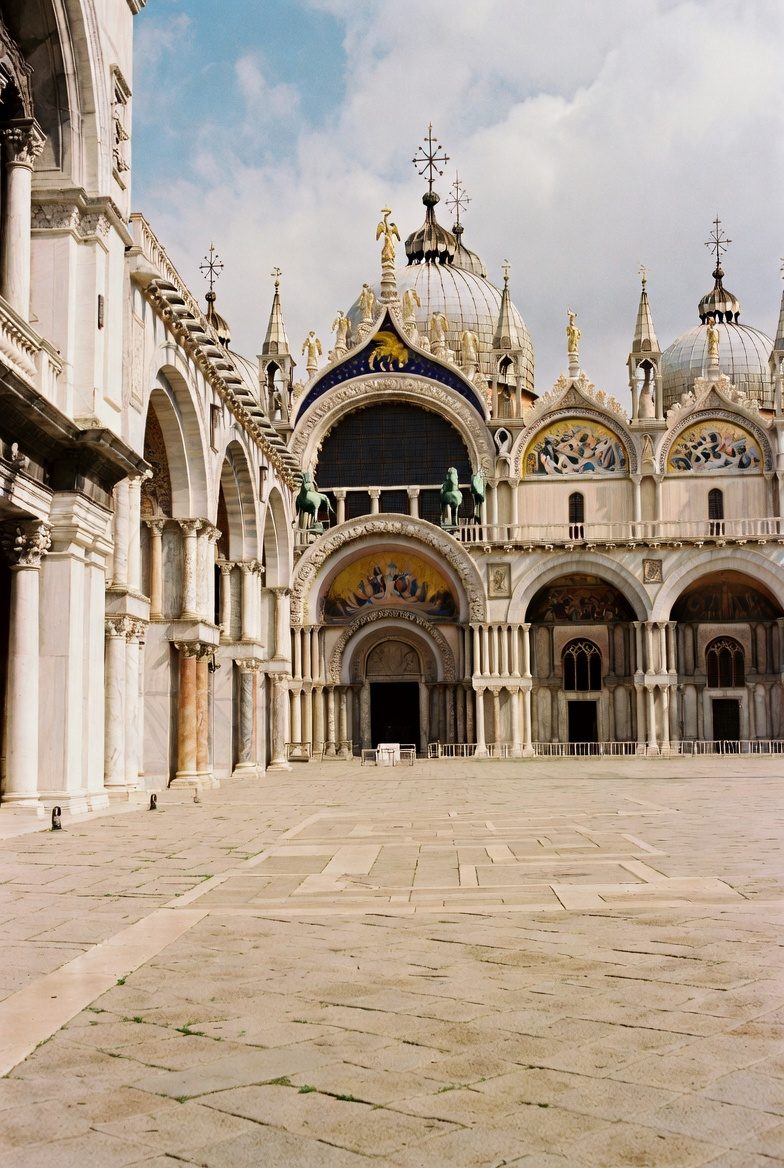
A Byzantine church grafted onto a Venetian piazza, faced in marble looted from a dozen ports, and roofed inside with eight thousand square metres of golden mosaic.
History
Begun in 828, the year two Venetian merchants stole the relics of Saint Mark out of Alexandria, the first shrine was a wooden chapel inside the doge's palace; a stone replacement followed within four years. The present basilica dates mostly from the 1060s, raised under Doge Domenico Contarini as a deliberate echo of imperial Constantinople. It remained the doge's private chapel — not a cathedral — until 1807, which is why it stands attached to his palace rather than to a bishop's seat.
Its plan is Byzantine: a Greek cross under five domes, copied from the lost Church of the Holy Apostles in Constantinople. Almost everything else — the four bronze horses on the loggia, the porphyry tetrarchs by the south door, the columns of the transept — was carried back from the East after the 1204 sack of Constantinople led by Doge Enrico Dandolo. The treasury behind the high altar is, in effect, the only surviving collection of the lost Byzantine imperial regalia.
The interior is gold from the springing of the arches up. Mosaics were laid down over six centuries — the ones in the atrium are 13th-century Old Testament scenes, the central dome is the Pentecost, and the apse is the Christ Pantocrator that watches the whole church from the east. Roughly eight thousand square metres of them survive, the largest single-program mosaic surface in Western Europe.
Behind the high altar stands the Pala d'Oro, an altarpiece of more than two thousand Byzantine enamels, gold and gemstones, assembled and reassembled between 976 and 1345. Saint Mark's relics were lost during a fire in 976 and miraculously rediscovered, the legend goes, when a hand emerged from a pillar to point them out — the spot is marked in the right transept. The basilica became Venice's cathedral only in 1807, by Napoleonic decree, replacing the older church of San Pietro di Castello.
Time the visit to the small windows of luce d'oro when the basilica is artificially lit — usually 11:30 to 12:45 — and the mosaics light up like a single sheet of foil.
Highlights
Pala d'Oro
A Byzantine altarpiece of gold, enamel and 1,927 jewels — the most concentrated treasure in the building.
Quadriga
The four bronze horses, taken from Constantinople in 1204; the originals are inside the museum, the copies on the loggia.
Treasury
Reliquary cabinets of looted Byzantine silver — including a rock-crystal lamp from a Fatimid caliph's palace.
Visit
- Address
- Piazza San Marco 328, 30124 Venezia
- Hours
- 9:30 – 17:15 Mon–Sat; 14:00 – 17:15 Sun
- Notes
- Reduced hours during liturgy. Cover shoulders and knees.
- Getting there
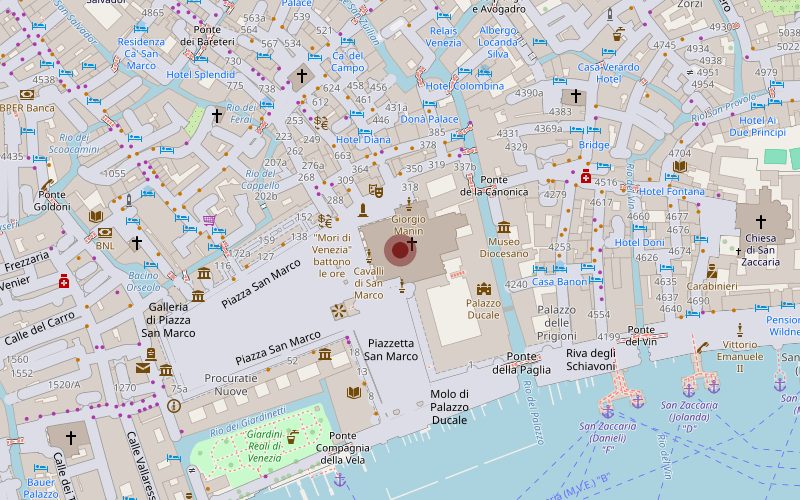
- Vaporetto line 1 or 2 to San Marco — Vallaresso. The basilica stands on the eastern end of the Piazza.
© OpenStreetMap contributors
See also
Santa Maria della Salute
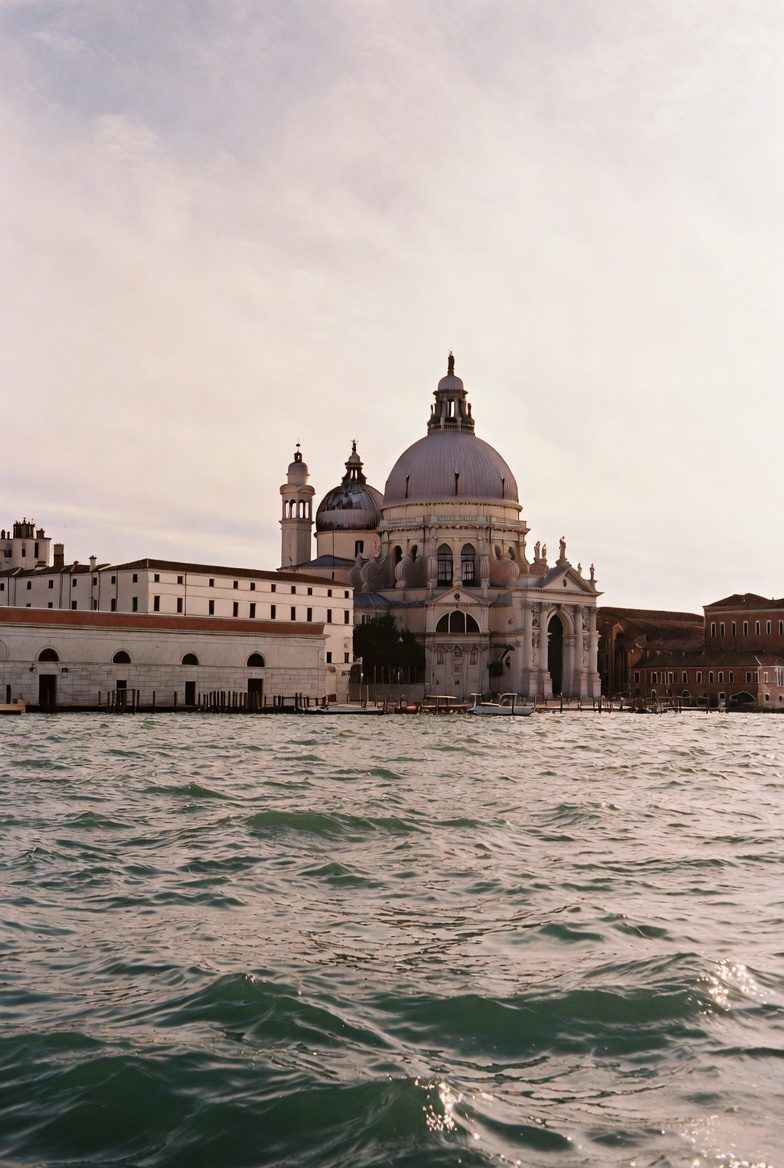
The white octagonal basilica that closes the Grand Canal, raised in thanks for the end of the 1630 plague and held up on…
Basilica dei Frari
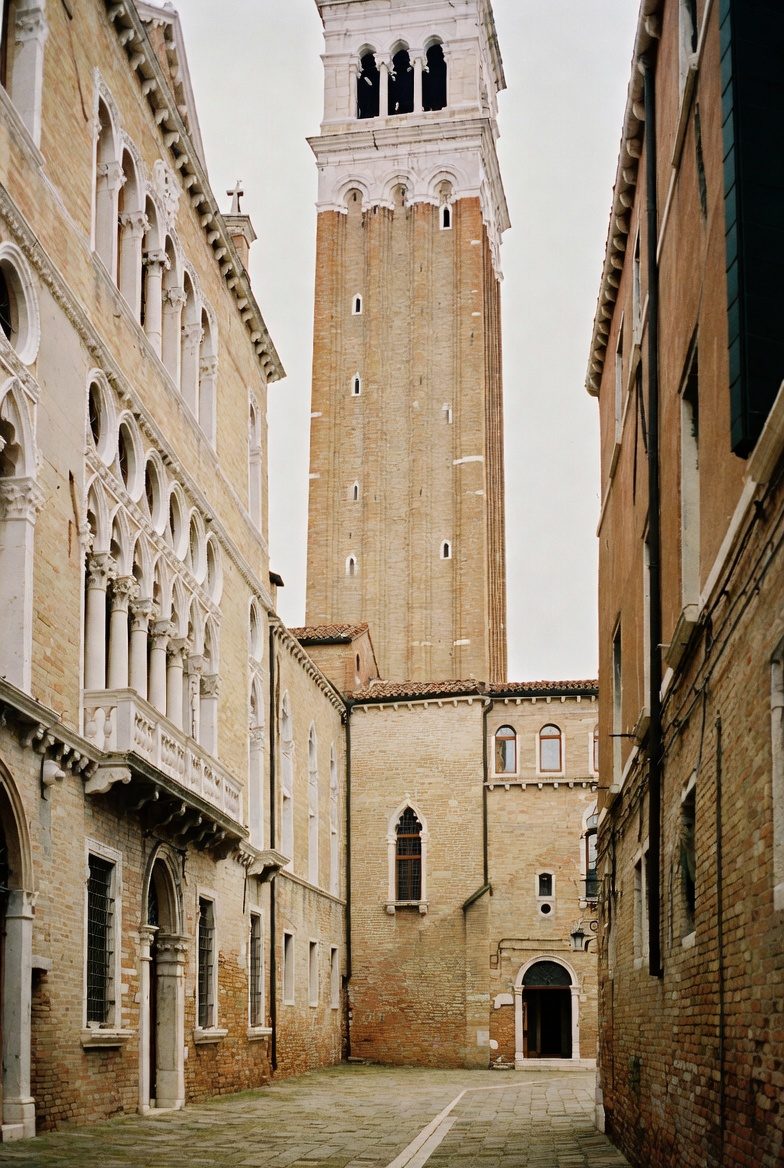
A vast brick Franciscan church that holds Titian's Assumption, his tomb, Canova's pyramid and the wooden choir…
Palazzo Ducale
For nearly a thousand years this was the political centre of the Republic — the doge's residence, the supreme court, the…