
Arsenale
The Republic's shipyard · 12th c.
The fortified shipyard that built and maintained the Venetian fleet for six centuries — once the largest industrial complex in pre-modern Europe and the model Dante used for his eighth circle of hell.
History
Founded around 1104 under Doge Ordelafo Faliero, the Arsenale started as a state-run repair yard for private galleys in a corner of the eastern lagoon. By the 13th century it was building Venice's own fleet; by the 14th it had absorbed three further expansions — the Arsenale Nuovo (1325), the Arsenale Nuovissimo (1473), and the Canale delle Galeazze (1564) — until it covered roughly fifteen percent of the entire city, the largest industrial site in pre-modern Europe.
At its 16th-century peak it employed sixteen thousand arsenalotti — caulkers, rope-makers, sail-cutters, gun-founders, oar-turners — who lived in the surrounding parish of San Pietro di Castello under their own laws and elected their own foremen. Dante had used the Arsenale as a simile for his eighth circle of hell in 1314: the boiling pitch, the workers running back and forth, the noise. Two centuries later it was still doing the same things, only better and faster.
Production worked on a near-industrial line a hundred and fifty years before England did the same. Standardised parts — pre-cut keels, pre-spun ropes, pre-poured nails — were stockpiled in dedicated warehouses; a galley hull would then be towed down the canal from one workshop to the next, emerging at the far end fitted with mast, oars, sails, ballast, water-casks, biscuits and weapons. In 1574 King Henri III of France, on a state visit, was given a demonstration: a complete galley assembled, launched and rowed past him in the time it took him to finish a ceremonial banquet, less than two hours.
The Arsenale supplied the Venetian victory at Lepanto in 1571, the largest naval engagement of the early modern period; the bulk of the Holy League's galleys had been built behind these walls. After the fall of the Republic in 1797 Napoleon stripped the yard, dismantled the wooden Bucintoro and burned its gilt for scrap. It became Italian state property in 1866 and is still partly an active naval base. Since 1980 the public-facing basins host the Venice Biennale architecture and art exhibitions in the old rope-walks.
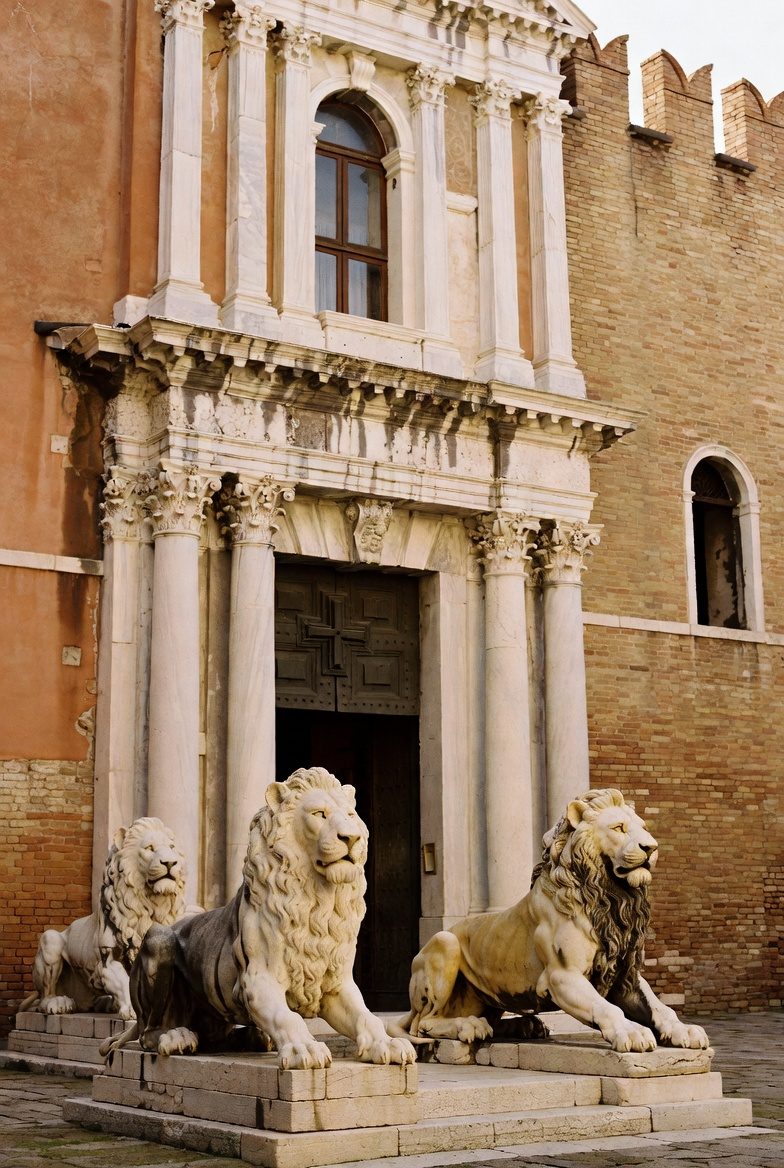
Even if you do not go inside, walk the long perimeter wall: the brick is medieval at the base, Renaissance higher up, and the lions guarding the land gate were carried back from Athens in 1687.
Highlights
The Land Gate
1460 Renaissance portal — the first classical structure built in Venice — flanked by lions looted from Piraeus.
The Corderie
Three-hundred-metre rope-walk, used during the Biennale; a single building containing a single very long room.
The walk along Rio dell'Arsenale
Walk south from the campo to see the inner gate from the water — the route the new ships took out into the lagoon.
Visit
- Address
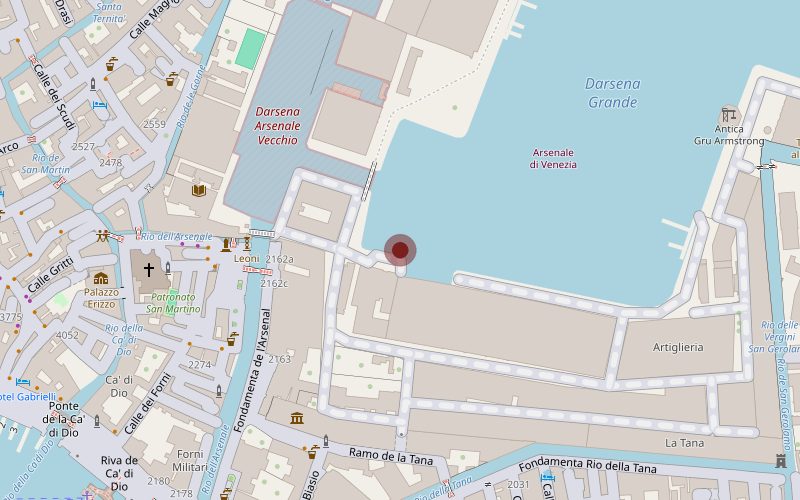
- Campo de l'Arsenal, 30122 Venezia
- Hours
- Outer entrance and walls always visible. Interior partly open during Biennale (May–Nov)
- Notes
- Most of the inner basins are still naval property and closed.
- Getting there
- Vaporetto line 1 or 4.1 to Arsenale. The land gate is on Campo de l'Arsenal; the water gate faces San Pietro di Castello.
© OpenStreetMap contributors
See also
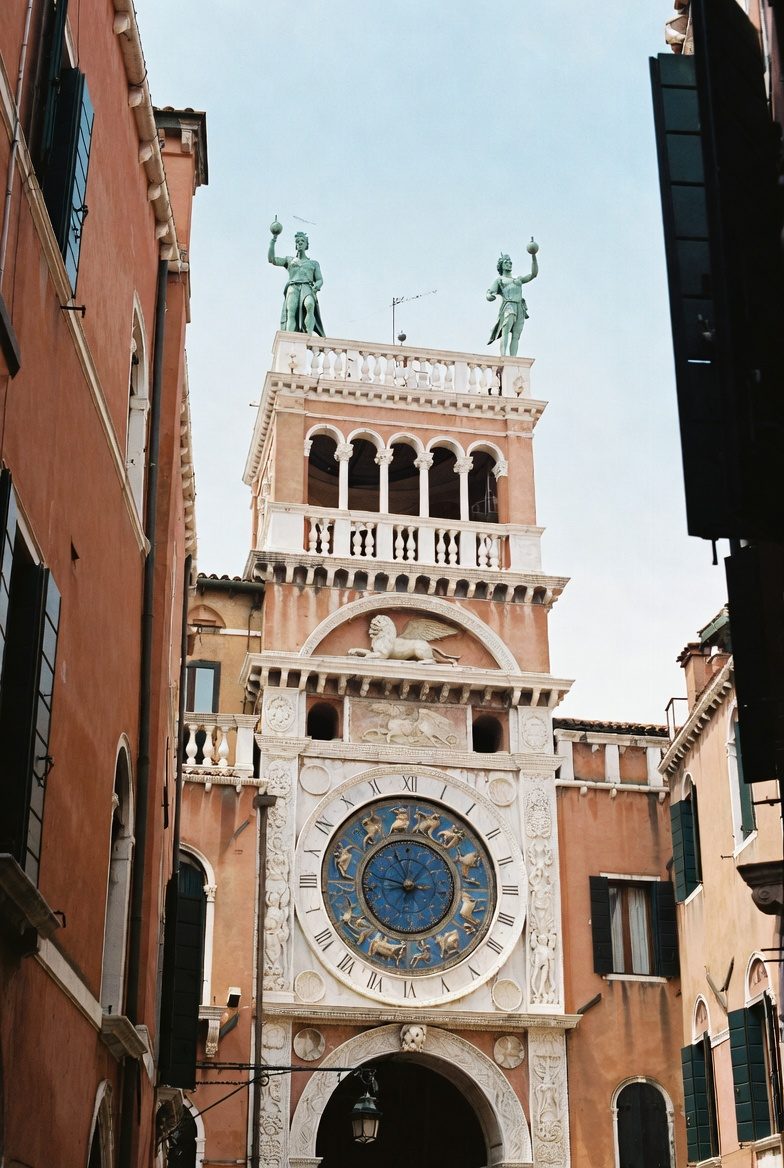
Torre dell'Orologio
The Renaissance clock tower that closes the north side of Piazza San Marco — astronomical dial below, golden lion above…
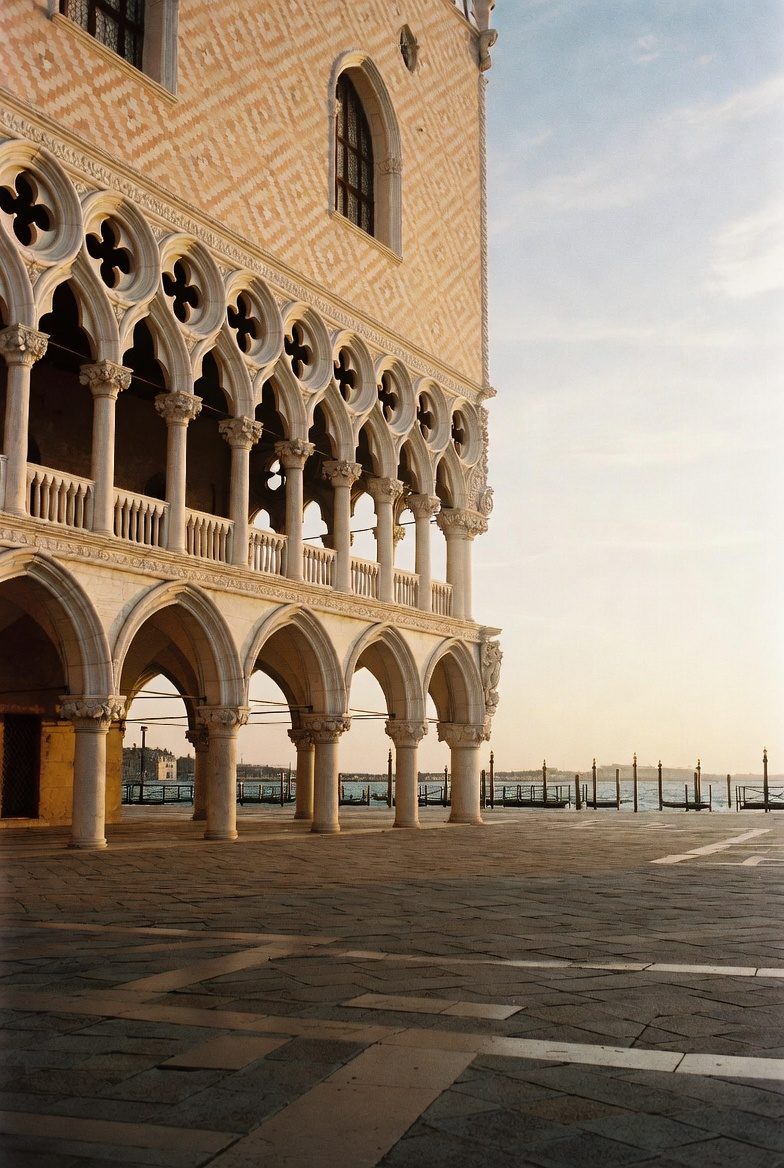
Palazzo Ducale
For nearly a thousand years this was the political centre of the Republic — the doge's residence, the supreme court, the…
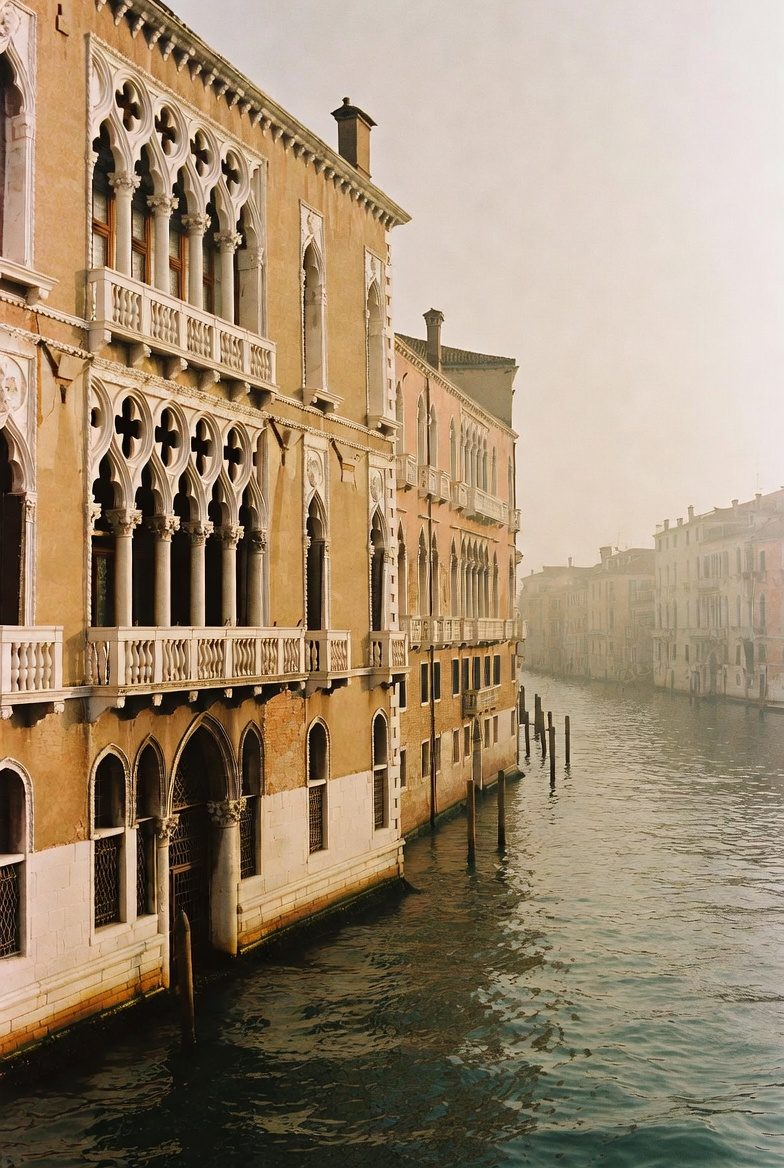
Ca' d'Oro
The most beautiful Gothic façade on the Grand Canal — once gilded leaf by leaf, hence the name, and now the home of a sm…